
Why successful facial rejuvenation starts with your family album, how I calculate your individual vector of aging, and why I am categorically opposed to “redesigning” someone else’s anatomy. Here is how I plan my surgeries.
When you come to me for a facial rejuvenation consultation, you most often point out isolated problems that upset you in the mirror: a “sagging” chin, heavy drooping eyelids, or deep nasolabial folds. But for me, plastic surgery is not local repair—it is large-scale architectural restoration.
I associate my work with the most expensive handmade craft in the world—the work of great couturiers. When the world’s best designers create their masterpieces, they work with the finest, most noble fabrics. The most expensive clothing is not mass production; it is a bespoke work of art called Haute Couture. Your face is the exact same unique creation, and its living tissues require delicate, manual, and highly artistic work. But in order to return these tissues to their pristine shape, elasticity, and ideal fit, I need to understand what they were like originally.
This is precisely why I often ask my patients to bring photos from 10–20 years ago to our first meeting. Your archival snapshots are not sentimentality to me, but a vital diagnostic tool that allows us to build an accurate roadmap for the upcoming surgery.
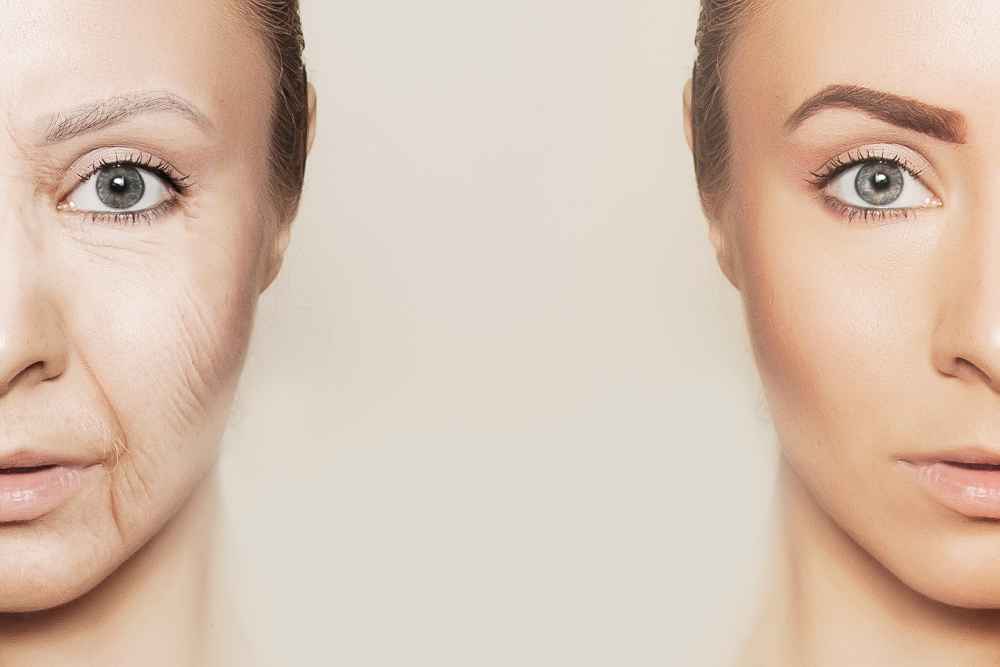
Anatomical archaeology: what I see in your old photos
Every person’s face ages according to its own unique, deeply individual scenario. At its core lie three key processes: resorption (loss) of skeletal bone tissue, stretching of the ligamentous apparatus, and redistribution (migration) of fat pads.
By analyzing your youthful photographs, I solve several fundamental tasks:
-
I determine your individual vector of ptosis and the influence of the dentition system. Living tissues do not just drop straight down—everyone has their own displacement vector, which directly depends on structural support. The facial bones are the foundation, and the teeth and jaws are its main load-bearing structures. Through old photos, I can clearly trace how your face’s geometry changed depending on your dental history. The loss of even a single molar triggers rapid resorption (volume loss) of the alveolar ridge of the upper or lower jaw. The bone shrinks, and the tissues covering it instantly “collapse” inward, forming early jowls, sunken cheeks, or deep marionette lines. Even in young patients, chronic sinusitis or severe, traumatic dental surgeries for acute inflammation (such as radical sinus lifts or maxillectomies) can lead to facial deformation. All of this destroys the bone framework, alters ligament tension, and entails localized ptosis. The same applies to past facial injuries—they permanently alter its deep architectonics. Photographs from your youth show me exactly where the volumes of your cheekbones, cheeks, and jawline were initially located before all these anatomical losses. During surgery, this allows me to return the tissues to their rightful, native anatomical position, delicately restoring their “fit” rather than artificially stretching them.
-
I recognize congenital asymmetry. Perfectly symmetrical faces do not exist. A slight brow tilt, different eye shape, or lip contour is often present from youth. It is important for us to document this together before surgery so we can clearly distinguish your unique genetic DNA, the consequences of old injuries, and acquired age-related tissue changes.
-
Prevention of “overcorrection” and standardization. I am convinced that global plastic surgery has long moved away from standardized, “Instagram” faces. My goal is not to cut a new face based on someone else’s template, but to return your own face by erasing 15–20 years from it. Archival shots help me recreate that very individual eye shape (in blepharoplasty) or defined oval (in a facelift) that made you unique.
“The greatest compliment for me as a surgeon is when people around notice that my patient has fantastically rejuvenated, rested, and refreshed, but no one can guess that surgery was performed. Old photographs help me turn back time without breaking the laws of your personal nature, creating true Haute Couture in plastic surgery.”


Instructions for you: what photos to bring to your consultation
For surgical planning, I do not need artistic portraits, but rather anatomical precision. Please look through your archives and select frames that match this checklist:
-
Age markers: Shots at the age of 20–25 (when the facial bone skeleton is fully formed and the dentition system is still intact) and 30–35 (when the first hidden tissue changes begin to show).
-
Angles for analysis: It is ideal if you find portraits in three projections—a strict full-face (frontal), a clean profile, and a three-quarter view (semi-profile).
-
Honest lighting: Look for photographs without harsh shadows, professional studio retouching, and beauty filters. Real facial geometry is what matters to me.
-
Static and dynamic: One shot should feature a completely relaxed face, and the second should show your characteristic, open smile.
The architecture of your youth
A plastic operation is a conscious step that requires trust, honesty, and serious planning. Analyzing your past—including injuries, surgeries, dental visits, and the pristine state of your tissues—is the only way for us to guarantee a predictable, safe, and most importantly, natural result in the future.
Bring your albums to my consultation. Let’s restore the history of your beauty together.
